POLICY REVIEW
Completed project for the National Security Council
In 2011, President Obama announced the Pivot to Asia. The intention was to shift U.S. diplomatic, military, and economic investments to the region. This remained a core intention for the next ten years.
My project shows how much the U.S. shifted its investments to the region. Conducting a comprehensive assessment required a combination of methods. This page covers these methods.
Based on this work, I discovered new trends in U.S. engagement and made a series of recommendations. To see the results of my work, feel free to check out the report below.

EXPERT CONSULTATION
Consulted with the former Chairman of the Joint Chiefs of Staff
Throughout this process, I consulted with my advisor, General Joe Dunford. He offered valuable feedback based on his extensive expertise and experience in the Indo-Pacific. With his help, I turned a few ideas into a major policy report.
I focused on two main research questions: 1) where are U.S. investments in the Indo-Pacific imbalanced? and 2) what can be done to fix these imbalances? Based on U.S. policy statements, I considered a balanced approach to be one where the Indo-Pacific becomes a primary destination for each investment type – diplomatic, military, and economic.

DATA COLLECTION
Built database on diplomatic, military, and economic investments
To find imbalances, I compiled a range of sources on U.S. foreign policy investments. These included diplomatic appropriations, treaties and international agreements, foreign assistance, leader travel, congressional hearings, students abroad, military deployments, arms sales, direct investment, and international trade.
All sources were comprehensive (meaning they included data for every country and every year over the past two decades). Many of these sources have no digital format. I converted and combined each source into a single database.

TREND ANALYSIS
Tracked trends in the allocation of investments
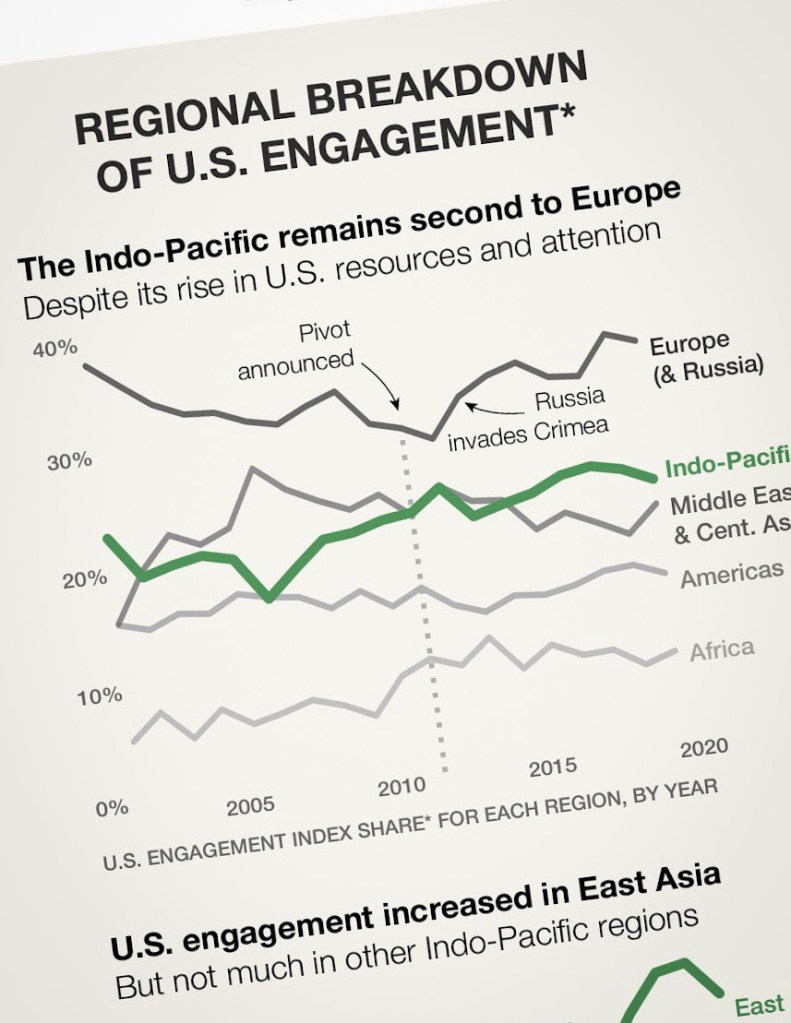
With a comprehensive database of U.S. foreign policy investments, I was able to track key trends for the first time. For example, I compared investment levels in the Indo-Pacific, before and after the Pivot. I compared investment levels between the Indo-Pacific and other regions. And I compared the balance between diplomatic, military, and economic investments.
This systematic focus on how the U.S. allocates its attention and resources made it possible to find major imbalances in U.S. Indo-Pacific Strategy.

CENTER OF GRAVITY
Mapped out diplomatic and military centers of gravity
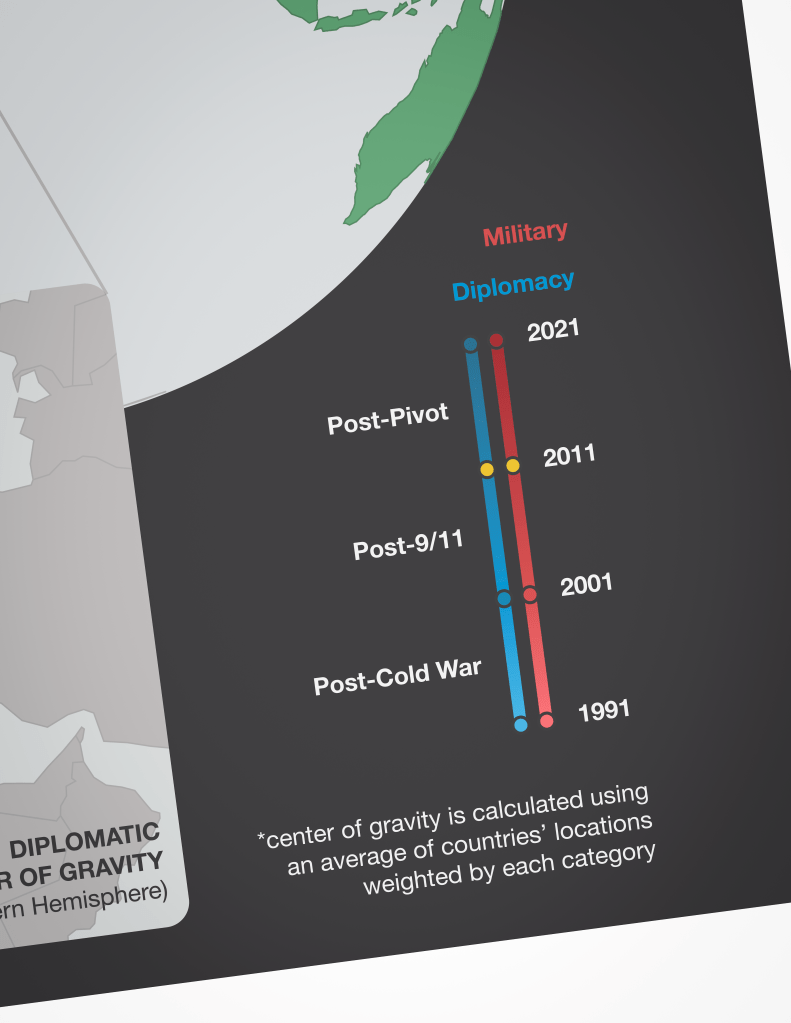
For some sources, I was able to gather information dating back to the Cold War. These included a few diplomatic sources (treaties and international agreements, foreign assistance, and leader travel) and military sources (troop deployments, ship deployments, and aircraft deployments).
This made it possible to examine trends over a longer timeframe and compare three distinct eras (post-Cold War, post-9/11, and post-Pivot).
By calculating centers of gravity for each investment, I was able to map out the shift in U.S. diplomatic and military engagement over the past three decades.
ENGAGEMENT INDEX
Created U.S. engagement index
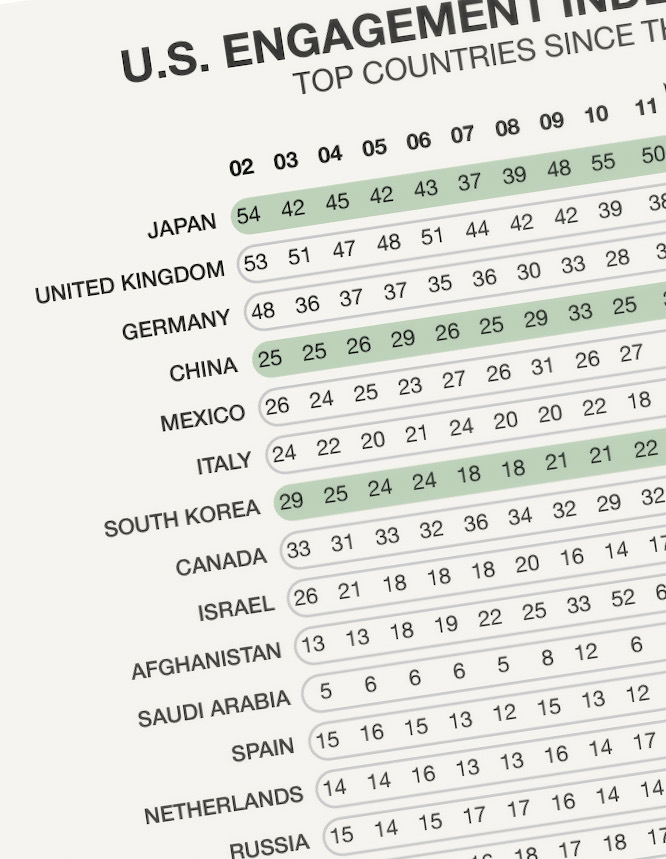
To compare foreign policy investments by location, I created an index. This made it possible to show how much the U.S. engages with each country.
The index accounts for each investment type. By compiling a range of diplomatic, military, and economic investments into one index, I was able to see how U.S. engagement with individual countries and regions has evolved.
SURVEY
Fielded nationally representative survey
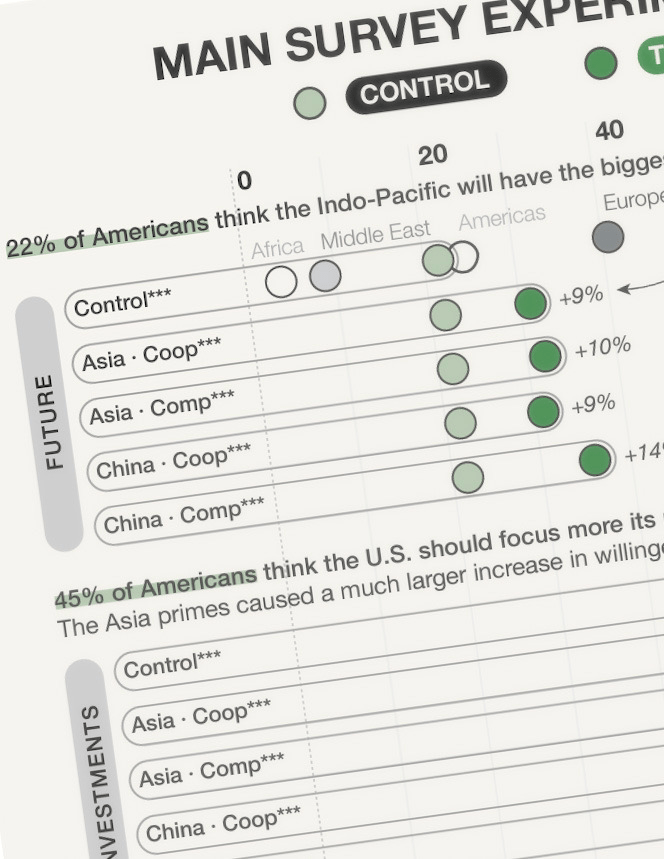
I designed this survey to answer two core questions: 1) how much do Americans value the role of diplomatic, military, and economic power? and 2) how much do Americans support increased engagement in the Indo-Pacific? The answers helped gauge the level of support for new policies.
I fielded this survey and received over two thousand responses (balanced by age, gender, ethnicity, and region).
EXPERIMENT
Conducted randomized control trial
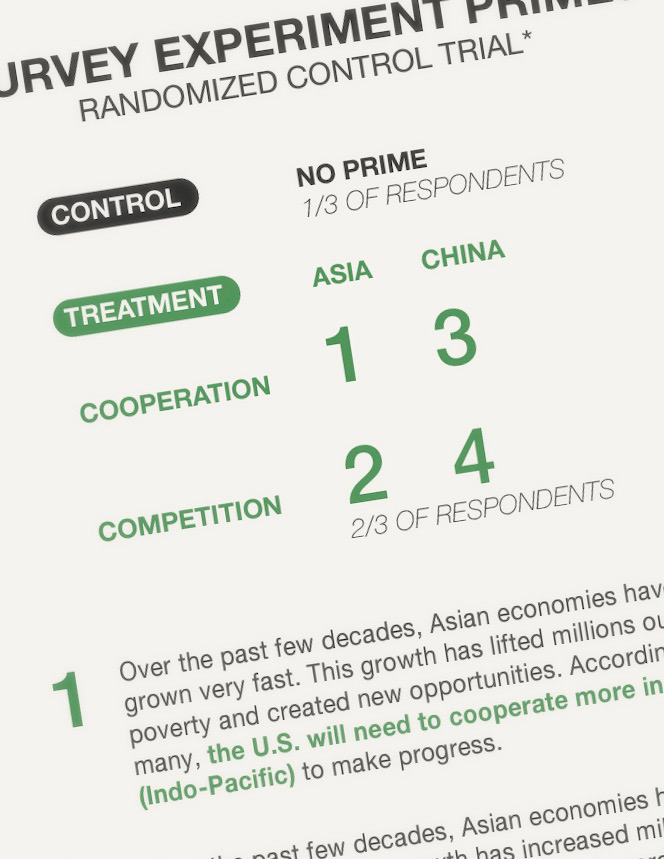
I also embedded an experiment within the survey. My goal was to see how American views change when presented with different messages about the Indo-Pacific.
One-third of respondents received no prime (message). The remaining respondents received one of four primes (such as statements that the U.S. will need to compete more with China or cooperate more in Asia). Each respondent was randomly assigned a message. This made it possible to measure the casual impact of receiving different messages.
VISUALIZATION
Designed series of graphics
To present my findings, I designed a series of graphics. Some are shown here. There are even more in the report. Given the amount of data that I tried to combine, my goal was to minimize complexity and bring the most important trends to the surface. To do this, I applied a range of graphic design techniques.
WRITING
Wrote and delivered report to the Coordinator for the Indo-Pacific
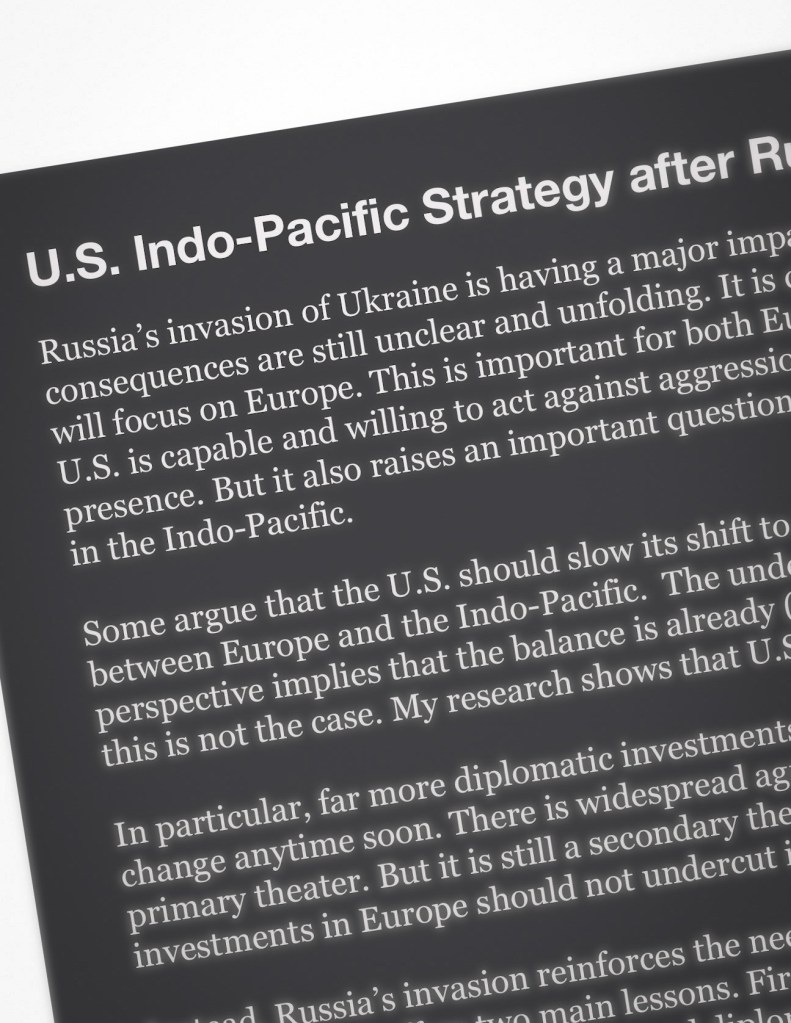
To write this report, I worked with my professor, Lauren Brodsky. She helped me build a compelling story. After developing a set of findings and recommendations, I sent this report to the National Security Council.
 Gabriel Coll